Coaching & Consulting
Coached investors end up with 100%-150% more wealth at retirement*. Coaching is your edge in investing.
In the investing world, there are institutional investors (pros), and there are retail investors (amateurs). The pros dominate daily trading activity, and while it's true that the average professional money manager slightly underperforms their benchmark, it's also true that the average retail investor earns far less than the pros do.
According to Morningstar and Dalbar Inc, the S&P 500 has averaged about 9.7% per year over the past 20 years. Over the same time period, professionals earned 7.8%, and retail investors earned 5.7%. (See chart at right)
Some of the reasons for this underperformance are a) lack of, or inadequate planning; b) lack of clearly articulated goals; c) holding on to losing positions too long; d) selling winners too soon; e) poor or inadequate defensive strategy.
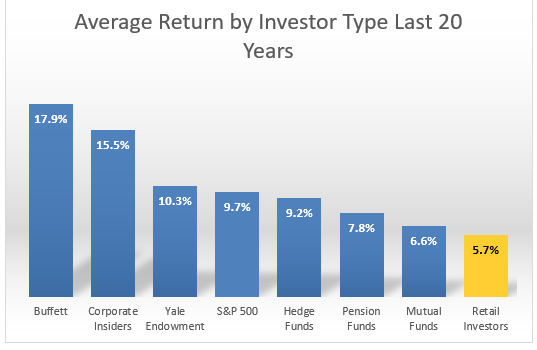
Source: Morningstar, Dalbar, Inc.
The Edge
A Well-Crafted Plan
The #1 reason retail investors underperform the market is a lack of serious planning. We show you, step-by-step, how to create a well-crafted plan.
Specific Rules for Buy-Sell-Hold
Part of your plan deals with the indecision most investors experience when the market misbehaves. We show you how to develop rules you can easily follow.
A robust defensive strategy
Every good Plan A needs a strong Plan B for dealing with market weakness or economic recessions. Our Plan B spells out all the steps in detail.
Automated triggers & alerts
Who has time to monitor their investment portfolio? We will show you how to automate this process, so that your portfolio will send you an alert when it needs attention.
Why you might need a coach

Lack of Clear Financial Goals
If you're investing without specific objectives or timelines, or if you're unsure how your investments align with major life goals like retirement, home purchases, or education funding, a coach can help establish a structured investment plan tied to your personal circumstances.
Time Constraints and Knowledge Gaps
If you lack the time or expertise to stay current with market developments, or you tend to make emotional investment decisions, an investment coach can provide education and ongoing guidance tailored to your needs.
Portfolio Complexity and Confusion
When your investment portfolio has become unwieldy with overlapping funds, unclear asset allocation, or investments you don't fully understand, a coach can streamline and optimize your holdings. This is especially relevant if you're holding numerous individual stocks without a coherent strategy.
Emotional Decision-Making Patterns
When you find yourself frequently buying high during market euphoria or selling low during downturns, an investment coach can help you develop disciplined strategies and emotional regulation techniques. If you're losing sleep over market volatility or making impulsive trades based on news headlines, professional guidance can provide valuable perspective.
How It Works
An brief introductory call gives us a chance to identify the issues that need work. Together, we will decide whether to pursue a coaching or consulting engagement, and what the terms will be.
Depending on the complexity of the issues we discussed, we might settle on one or two full sessions (60 minutes), or we may decide to work together for a longer engagement, perhaps speaking weekly or monthly.
The bulk of our work will be done in the context of a formalized investment plan. This is where nearly every aspect of investment decision-making will live. This will take the longest time to complete.
Once your Plan A is complete, we will work on your Plan B defensive strategy. This sub-plan could be triggered by price action, or market conditions, or economic conditions. You will know exactly what to do.

foot race
It's Not a Sprint, it's a Marathon
Building and maintaining a high-performing portfolio is a lifetime commitment with high stakes. If you want professional advice at a fraction of the cost of brokerage you already pay, stick around. You might just learn something.

Case Study: Elizabeth
Elizabeth came to me after suffering years of sub-par returns on her portfolio. I quickly found out that she was only investing in tips she got from co-workers and friends. She had no structure, no asset allocation scheme, no plan, and no process.
We went to work right away on devising a plan that fit with her money goals. She now has the tools and the skills that go with them to research the stock tips she gets, plus ideas she comes up with on her own. She's doing much better now.
Case Study: Duane
Duane thought of himself as the next Warren Buffet, but he wasn't. He was not accounting for things like cash on hand, additions and disbursements from the account, and so on. As a result, he was under the false notion that he was making upwards of 15% per year on his money, when the truth was closer to 8%.
After we tackled that problem, I set him up with a monitoring and rebalancing scheme that takes most of the guesswork out of the process.
Case Study: Angela
Angela had a completely different problem. She owned more than 120 companies, ETFs, CEFs, bonds and bond funds, and even a couple of option contracts. She was so busy checking news and prices that at times she neglected her work. Not any more. We took a sharp blade to her holdings, and if she couldn't explain to me why she should hang on to the position, then it had to go. It was a little bit of tough love.
Now Angela has 52 positions and she understands how each one makes money. We don't anticipate adding any more names to this list. Angela is able to handle these 52 without undue stress, but she knows if she begins to add more, her anxiety level will go up along with it.
I started out with the second opinion plan but quickly realized I needed more help. Erik gave me credit towards the deep dive plan so it didn't cost me any more. Erik really knows his stuff and I'm glad I found him.
Sam Margolis
UI/UX Designer
I didn't know what I was doing and I didn't know where to go for help. A friend suggested hiring an investment coach because they charge by the hour and don't take possession of your account. I was comfortable with my broker so I chose to hire a coach. Erik is a great coach.
Margaret Welcenbach
Retail Store Manager
The thing I liked most about Erik's plan was the defensive part. Now that I have it all mapped out, I can relax because I will know what to do when I get alerts about a position or the market in general. It's something I wish I had heard about years ago.
Timothy Carpenter
Engineering Consultant
Pricing
Frequently asked questions

About Our services
The lease expensive would be a single, 1 hour session by phone, which would cost $200.
Normally, there are two calls of 1 hour each, plus background work.
More than 35 years. I've always been involved in coaching in my day jobs because it's what I like to do and because I'm pretty good at it.
*Source: Lusardi & Mitchell 2014