

The bull market that began in October 2022 is in its late stage, as technical factors are starting to break down. Market themes are shifting, and investors are positioning for a slowing economy and a stock market that looks headed for a 10-15% correction. The Mag 7 stocks are struggling as investors rotate into mid-caps and small caps. Tech in general is losing appeal as investors rotate into Energy, Consumer Staples, and Basic Materials.
This article highlights 3 stocks that I believe have been unduly punished by investors seeking to raise cash any way they can. This fear-driven selling always opens up some opportunities to buy the best companies at bargain prices. Here are the three I have for you today.
Boyd Gaming (BYD)
Boyd Gaming is one of those companies that’s been around long enough, and stayed disciplined enough, that it’s easy to forget just how big it actually is. On paper, it’s a six billion dollar casino and hospitality operator with 28 properties across ten states, stretching from Nevada to Pennsylvania. But the company still acts like a family-run business, which makes sense given its roots.
Sam Boyd started out as a dealer in Las Vegas back in the 1940s. He slowly worked his way up the chain of command and eventually teamed up with his son Bill to open their first property under the Boyd name in 1975. That family run mentality still shows up in how the company describes itself and how it treats its customers.
If you look at Boyd’s profile today, it’s a mixture of regional properties scattered across the Midwest and South, and a surprisingly strong presence in downtown Las Vegas. The company has carved out a niche by focusing on regular players rather than the high roller glamour that the Strip chases. Their properties tend to be comfortable, familiar, and built for repeat visits. There are lots of slots to play, plenty of food options, and a successful loyalty program (Boyd Rewards) that ties everything together. It’s not flashy, but it works.
One thing that often surprises people is how much of Boyd’s success comes from understanding specific customer groups. A classic example is the way the company has become a favorite among Hawaiian visitors to Las Vegas. That’s not an accident. They’ve catered to that market for decades, and it’s become an important competitive advantage. They’ve also expanded into regional markets where customers want value, consistency, and a place that feels like “their” casino. Boyd isn’t trying to be MGM or Caesars. They’re playing a different game, and they’re good at it.
In recent years, Boyd has also pushed into digital gaming. Their Boyd Interactive division handles online casino operations in the U.S. and Canada, and they’ve built a unified tech platform that connects online play with on property rewards. They even sold a major stake in FanDuel for $1.755 billion, which gave them a pile of cash to reinvest in expansions like Sky River Casino and a planned $750 million resort project in Norfolk, Virginia. It’s a classic Boyd move: disciplined, opportunistic, and focused on long term returns rather than chasing whatever’s trendy.
Financially, Boyd has historically been sturdy. Their properties generate strong cash flow, and they’ve kept their cost structure under control. Slots are the engine of the business, and slots revenue is predictable. Even during industry shakeups, Boyd has usually managed to stay on its feet by sticking to what it knows best: disciplined capital allocation.
Boyd Gaming by the Numbers
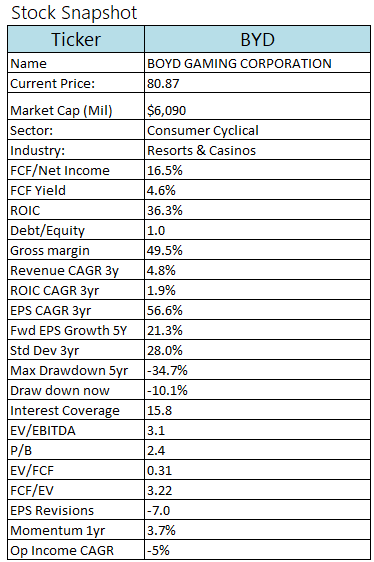
O.K. Maybe this table has a little too much information, but my philosophy is to give you more than you need and let you decide which metrics are important to you. I will show my own assessment of what these metrics mean to me next.
The Metrics Schema
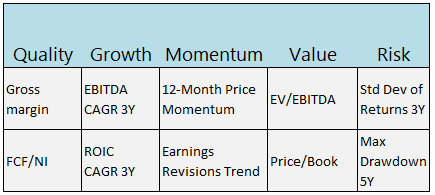
I evaluate stocks by looking at them from five different angles. I rate them on Quality, Growth, Momentum, Valuation, and Risk. The table below shows which metrics I use for each of the 5 categories.
The Dashboard
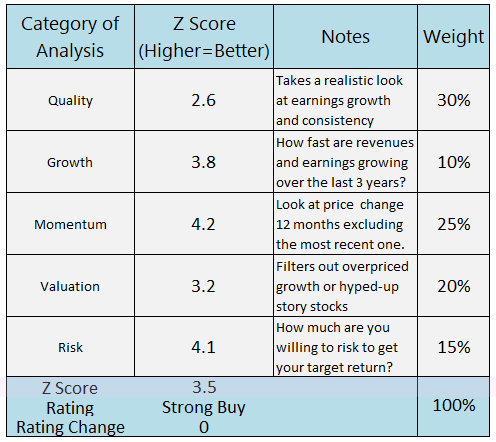
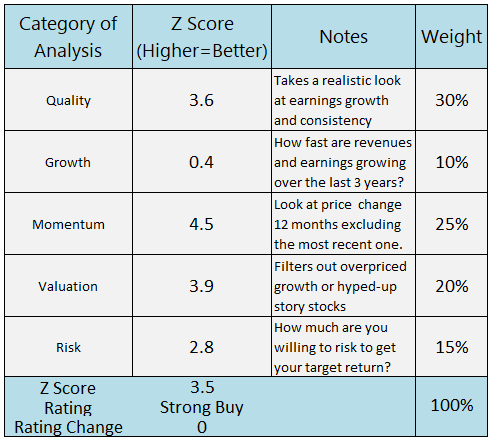
With a Z Score of 3.5, Boyd Gaming is a strong buy. Las Vegas has changed drastically over the last 10 years, and Boyd is very adept at figuring out how to position themselves to take advantage of the changing landscape. I view today’s price as a great opportunity to buy quality at a reasonable price.
Goldman Sachs (GS)
Goldman Sachs, the brokerage firm-turned-investment bank-turned-regular bank, has been around for 150 years. That longevity is partly derived from the firm’s knack for showing up in the middle of big financial moments and being on the right side of the trade.
What makes Goldman interesting is how it’s managed to stay profitable through wave after wave of changing market regimes. The firm built its reputation on advising companies, underwriting deals, and helping clients raise capital, but it never stopped expanding. Today, it’s a global operation with tens of thousands of employees, offices in major financial hubs, and a menu of businesses that ranges from investment banking to trading, asset management, and wealth management. It’s one of the largest investment banks in the world by revenue, and it consistently ranks near the top of the Fortune and Forbes lists.
Goldman structures itself around a few big engines. There’s the Global Banking & Markets division, which includes classic investment banking such as M&A advice and capital raising, and the FICC side, where they trade bonds, currencies, and commodities. That’s the part of the firm that deals with liquidity, market‑making, and all the behind‑the‑scenes activity that keeps financial markets functioning. Then there’s the Asset & Wealth Management division, which oversees trillions of dollars for institutions and individuals. It’s a mix of equities, fixed income, alternatives, and customized strategies for clients who want something more exotic and tailored to their specific needs.
But Goldman’s story isn’t just about products and divisions. It’s also about influence. The firm has produced a long list of alumni who’ve gone on to run major companies, shape policy, or take on high‑profile public roles. That’s part of why Goldman has a reputation—fair or not—for being deeply embedded in the global financial system. It’s considered a systemically important institution, which basically means regulators keep a close eye on it because what happens at Goldman tends to ripple out to the economy at large.
So, if you strip it down, Goldman Sachs is a firm that grew from a small family business into a global financial institution without losing its appetite for reinvention. It’s big, influential, sometimes controversial, but always central to the conversation about how modern finance works. And for better or worse, it’s hard to imagine the financial world without it.
Goldman Sachs by the Numbers
The Metrics Dashboard
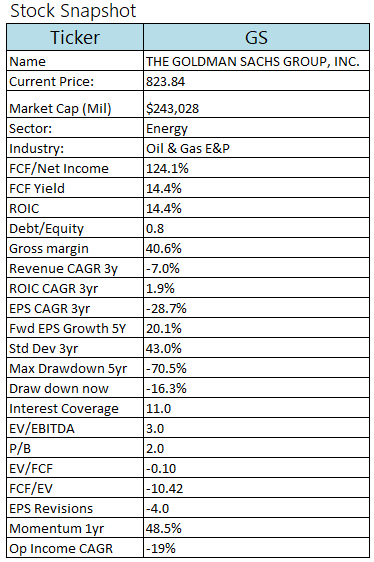
We’re living through some very rough waters today, and at times like this, I turn to companies with high quality, a dominant market share, and best-in-class services. Goldman meets all three of those criteria.
Innoviva (INVA)
Innoviva is a little-known healthcare company that doesn’t act like a typical biotech. Instead of betting the ranch on a single drug, Innoviva has built a hybrid model: part royalty collector, part specialty‑drug designer, part opportunistic acquirer. It’s a mix that gives the company a strong and steady stream of revenue and earnings, even though it operates in riskier areas like infectious‑disease treatments. As any seasoned investor knows, taking prudent risk is a path to outperformance.
Innoviva’s main source of income is its royalty portfolio. These royalties come from long‑standing partnerships, most notably with GlaxoSmithKline, on inhaled respiratory drugs like Breo/Relvar Ellipta and Anoro Ellipta. These are the type of drugs that aren’t new or flashy, but they produce reliable income streams.
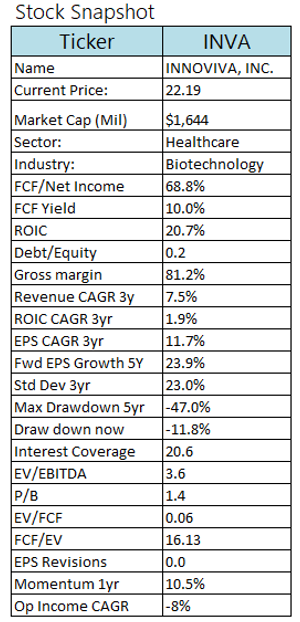
That steady royalty stream is one of the reasons why Innoviva’s financials look so different from the financials of the typical biotech firm. In the most recent reporting period, the company generated over $411 million in TTM revenue. Net income came in at $270 million, which is unusually strong for a company of its size ($1.7 Bil market cap).
But Innoviva isn’t resting on its laurels. Over the last few years, it has been building a portfolio of specialty drugs, mostly in the infectious disease and critical care spaces. These include treatments for things like hospital‑acquired pneumonia, complicated abdominal infections, and even drug‑resistant bacteria. The company also recently picked up NUZOLVENCE, a best‑in‑class oral antibiotic for uncomplicated gonorrhea, which just received FDA approval. That’s a big deal because it gives doctors a pill‑based option instead of the usual injection delivery method.
Financially, Innoviva looks “cheap but good”. The stock trades at a P/E ratio of 6.9, which is low compared to most profitable healthcare companies. Furthermore, with a beta of just 0.42, it’s not your typical volatile biotech. Analysts currently have a price target around $33-$34, implying a 45% upside over the coming 12 months.
So, what’s the catch? Well, the royalty business is stable but not fast‑growing. Respiratory drugs aren’t exactly a booming category, and long‑term, those royalties will probably begin to taper off. That means Innoviva needs its specialty‑drug portfolio to pick up the slack. Some of those drugs have real commercial potential, but they’re also in competitive markets, and hospital‑based drugs can take time to reach a wider market.
Another thing to keep in mind is that Innoviva has a history of being very active with capital allocation. It has bought back stock, acquired companies, and reshuffled its portfolio more than once. Depending on your perspective, that’s either a sign of a nimble operator or a company still figuring out exactly what it wants to be. The CEO has recently outlined a three‑part growth plan and a $125 million buyback, which suggests they’re leaning into the “active capital allocator” characterization.
From a risk standpoint, Innoviva is in a better position than many small‑to‑mid‑cap biotechs. It’s profitable, it has multiple revenue streams, and it doesn’t rely on a single FDA approval for survival. But it’s also not a pure‑play growth story. Think of it more like an unusually structured healthcare holding company. It’s part steady royalty income, part infectious‑disease specialist, part opportunistic buyer of overlooked assets.
Innoviva is a steady, slightly eccentric operator in a sector full of boom‑or‑bust stories, and that alone makes it worth a closer look.
Innoviva by the Numbers
The Metrics Dashboard
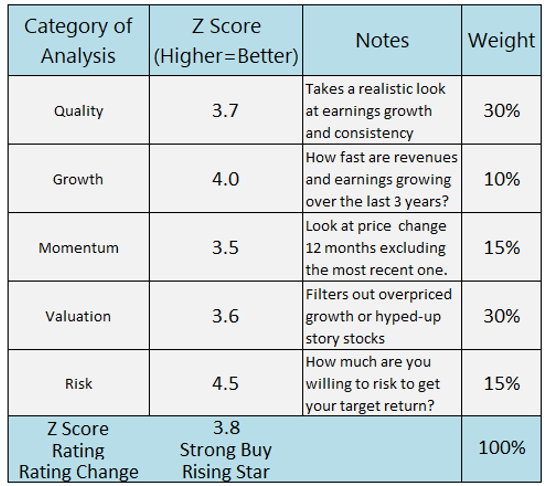
This is a very strong stock. I rate it a Strong Buy, and because I recently upgraded it from Buy to Strong Buy, I consider it a Rising Star.
Innoviva Inc. scores well in all five categories, which is rare. And it is especially rare for biotech companies. Small caps and Healthcare companies are on the rise as the stock market rally matures, and this stock checks both of those boxes.
Wrap UP
These are three different stocks, from different industries, that are exhibiting strong fundamentals. When we come out of the rough patch in the market, I believe that these three will be among the leaders in their peer groups. Quality at a reasonable price. That's what I'm advocating here.