

There are two economies in the world. The visible economy that governments track, tax, and report on. And then there's the shadow, or black market economy that escapes the rule of law, the tax man, and government regulators.
This article takes a look into the 14 largest and most profitable businesses in the world from both of these economies.
The Shadow Economy and The Visible Economy
According to Steven Levitt and Stephen Dubner's Freakonomics blog, the shadow economy is the second largest in the world. "By 2020, the OECD predicts the shadow economy will employ two-thirds of the world's workers. This new economy even has a name: 'System D'."
In an article for Foreign Policy magazine, Robert Neuwirth argues that "the $13 trillion global black market is the world's fastest growing economy -- and its future". According to Neuwirth, "System D is growing faster than any other part of the economy, and it is an increasing force in world trade".
Neuwirth explains that based on estimates, the total value of System D globally is close to $13 trillion. In comparison, the US has a GDP of $24 trillion. Thus, were System D a sovereign nation, it would be an economic superpower -- the second largest economy in the world.
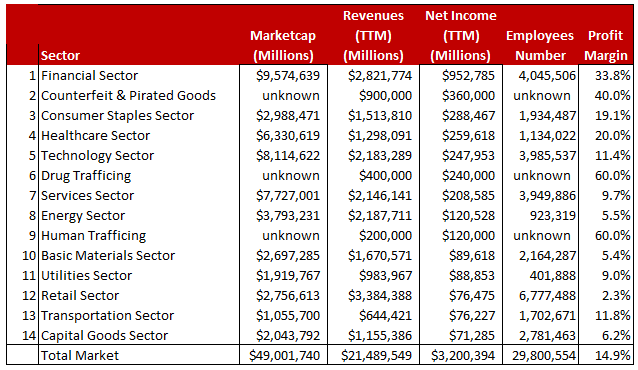
Next, we will examine each of the 10 major industries that make up 92% of the global economy, including those that are part of the shadow, or black market economy. You will find a table that shows the details for each of these industries later in this article.
#10. Basic Materials - $89 billion net income
This is another unglamorous sector of the economy. It provides the building blocks for everything from skyscrapers, bridges, tunnels, dams, roads, etc.
#9. Human Trafficking - $140 billion net income
This is a very big business, and it’s one of three sectors of the shadow economy that make the list. Human Trafficking is Big Business. It earns profits of roughly $200 billion a year for traffickers, according to the ILO report from 2023.
#8. Energy - $121 billion net income
Everything that’s taken out of the ground and turned into fuel is part of the energy complex. And green energy sources like wind, solar, and ocean currents are also included.
#7. Services - $208 billion net income
Every consumer has a basic choice to make – either do it yourself or pay someone else to do it for you. The services sector is the grand total of all the money spent on having someone else do things for you.
#6. Illicit Drug Trafficking - $240 billion net income
From the Mexican drug cartels to the corner crack dealer, this is a huge industry. According to a report by Global Financial Integrity (GFI) - Transnational Crime and the Developing World - which evaluates the extent of, and trends within, transnational crime. According to the document, the global market in drug trafficking has an estimated annual global value of between $40 billion and $60 billion (USD), making it the second most lucrative illicit market measured after that of counterfeit and pirated goods, which is estimated to generate as much as $1.13 trillion annually.
Marijuana, cocaine, heroin, oxy, fentanyl, MDMA, and other illicit drugs are estimated by the DEA to be a $55 billion industry worldwide.
#5. Technology - $348 billion net income
Perhaps more than any other industry, technology has been responsible for progress, increasing living standards, and innovation of all types. I think it deserves its spot at #5.
#4. Health Care - $260 billion net income
Doctors, hospitals, pharmaceuticals, in-home care, nursing homes – they all add up to a major part of world GDP. Many countries provide free health care, but it’s not really free. The taxpayers subsidize the costs.
#3. Consumer Staples - $288 billion net income
Food, water, and other daily essentials are included in this sector of the economy. When we add this sector to the Retail sector it makes more sense. Consumers spend most of the money in our economy.
#2. Counterfeit & Pirated Goods - $360 billion net income
That Rolex knockoff or that fake Luis Vuitton handbag are big business. There are entire networks of highly organized counterfeiters and Pirated Goods out there, and they make a ton of money in the shadow economy.
Not included in this category are the ill-gotten gains of the Mafia, both in the U.S. and Russia and elsewhere. Much of it is drug money, but there are other “services” that these hoodlums provide, like protection from bigger hoodlums.
#1. Financial Services - $1,252 billion net income
We have arrived at the top of the global economy food chain. Banking, insurance, investment advice and management, hedge funds, accounting are all part of this monster of a gravy train. There was a time, many decades ago, when the financial services sector was a relatively small player in the global economy. Their job was to provide funding to businesses who wanted to expand their reach.
Investment advice was a sleepy subsector of this industry. There were no hedge funds. Now they control $5 billion in client assets and charge outrageous fees.
The mutual fund industry took off in the 1970s, and Jack Bogle arrived on the scene as a kind of Robin Hood, offering ultra-low-cost index funds to replace high-fee mutual funds.
My observations
The financial services industry provides an essential service to businesses, governments, and consumers. They facilitate new business startups, finance infrastructure projects, and maintain fair and orderly capital markets. But I have a problem.
The financial services industry has become the dominant force in the global economy. I don’t think it’s healthy to have an industry whose purpose is to support and encourage real innovation and progress to become the dominant player.
While startup businesses are struggling to make their mark by offering innovative products and services, the financial services industry is essentially just shuffling papers from one department to the next.
They found a way to make a ton of money in the 1980s with leveraged buyouts financed with junk bonds. That didn’t end well.
They then found a way to make a ton of money in the 1990s by financing technology startups that had no earnings, but they were good at capturing eyeballs and clicks. That didn’t end well either.
Then they found a way to game the mortgage market by combining crappy mortgages with decent mortgages and getting the ratings agencies to give them their stamp of AAA approval. That didn’t end well either.
The Bottom Line
Congress has to get tougher with the financial services industry. Bill Clinton caved in to pressure from Republicans when he authorized the repeal of Glass-Steagall. This opened the door to all kinds of misbehavior by the finance industry. And the worst part was that the Treasury and the Fed bailed them out when these toxic mortgages went belly-up.
I don’t want to see a repeat of this but the AI boom we’re on right now seems destined to end up in another major financial crisis. It might be years away, or it might me months away.
The 14 Most profitable industries in the world
Sources used in this article
https://www.imf.org/~/media/Files/Publications/WP/2018/wp1817.ashx
https://csimarket.com/Industry/Industry_Data.php
https://eresearch.fidelity.com/eresearch/markets_sectors/sectors/sectors_in_market.jhtml
http://freakonomics.com/2011/11/01/the-black-market-is-the-second-largest-economy-in-the-world/
https://foreignpolicy.com/2011/10/28/the-shadow-superpower/
https://bluewatercredit.com/ranking-biggest-industries-us-economy-surprise-1/