

There is no reward without taking some risk
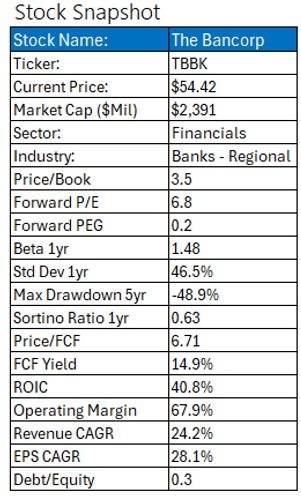
The risk/reward profile for The Bancorp (TBBK) at $52 starts with the simple fact that the stock’s recent decline is tied to well‑documented issues, not a flaw in their business plan or the execution of it. The data shows three main causes of the price weakness:
- A Q4 earnings miss and guidance cut
- A class‑action lawsuit tied to amended financials
- Mixed analyst sentiment
None of these undermine the core economics of the business, which are financial strength, fast growth, cheap price, but poor momentum and above-average risk. I will lay out the bull and bear case, run the numbers, then let you decide whether TBBK is worth a look.
The Bull Case
TBBK’s long‑term earnings power remains intact, and several developments support an optimistic view:
High ROIC despite the earnings miss - The company posted a 40.8% ROIC even in a messy quarter, showing that the underlying growth is still strong.
Aggressive buybacks - Management repurchased $150M in Q4 and plans $200M in 2026, which supports EPS even with lower guidance.
Long‑term roadmap - The “Project 7” plan targets a $7.00 EPS run‑rate by Q4 2026 and $8.25 in 2027, suggesting meaningful earnings growth beyond the near‑term softness.
Fintech sponsorship momentum - The high‑margin, capital‑light embedded‑finance model continues to scale, and no major partners have left.
At $54, the stock trades well below the consensus analyst target of $68.20, which represents a 31% upside from here. The stock is also well below its 12‑month high of $81.65. That creates a valuation gap where expectations have already been adjusted downward.
The Bear Case
The risks are real but well-known.
- Q4 EPS of $1.28 missed the $1.46 consensus, and FY2026 guidance was lowered to $5.90.
- The amended annual report and resulting lawsuit raise questions about internal controls.
- Ratings range from Strong Buy to Hold, with some firms citing the guidance cut and valuation compression.
- Higher provisions and weaker leasing results contributed to the miss, though management has already begun pivoting away from this segment.
These risks explain the stock’s pullback, but they do not point to a structural break in the business model.
Why the consensus rating among analysts is “Hold”
The Hold rating is due to a combination of recent negative surprises and a small analyst universe, which amplifies each rating.
- Analysts tend to move to Hold when visibility drops, even if long‑term fundamentals remain strong.
- William Blair initiated coverage at Market Perform with a $60 target, citing the guidance revision.
- Across all firms, the consensus is actually “Moderate Buy,” but the presence of Hold ratings pulls the label down.
- With the stock trading well above analyst targets last year, some firms were reluctant to maintain Buy ratings.
The Hold label reflects short‑term caution, not a negative view of the long‑term model. The key question is whether the issues that caused the price weakness are temporary or permanent. Based on the evidence:
- The earnings miss is real, but the underlying ROIC and revenue growth remain strong.
- The guidance cut resets expectations but does not undermine the long‑term earnings trajectory.
- The reporting issues are serious but already disclosed and being addressed.
- The fintech sponsorship business continues to grow, and buybacks support EPS.
- Analyst caution is tied to near‑term visibility, not structural concerns.
At $54, the stock reflects these risks, but the potential rewards in the long run far outweighs them.
First, here's a look at some of the metrics that I use to score a stock on a 0-5 scale.
A deep dive into 5 categories of metrics
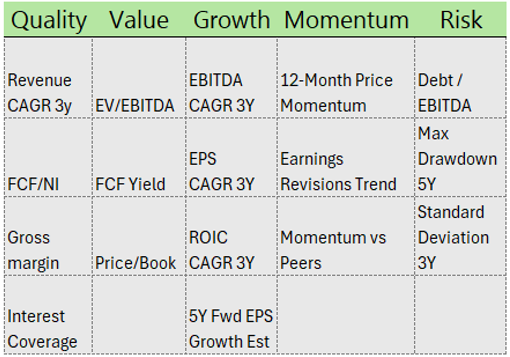
When I evaluate a company, I look at 5 categories of metrics: Quality, Value, Growth, Momentum, and Risk. This gives me a well-rounded picture of the company's financial strength, historical price patterns, and forward-looking indicators for sales and earnings.
Now let's look at each category, starting with Quality.
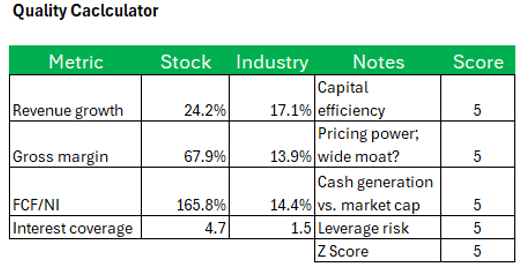
The quality score is a perfect 5 out of a possible 5. All four of our metrics look good. Revenue is growing much faster than industry peers. Gross margins are fat. The company is generating an abundance of free cash flow. And they have a sturdy balance sheet with more than enough interest coverage.
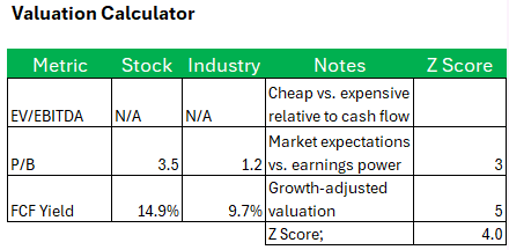
Just as we would expect from a company that recently missed their earnings number, valuation for TBBK is a solid 4 out of 5, indicating very good value.
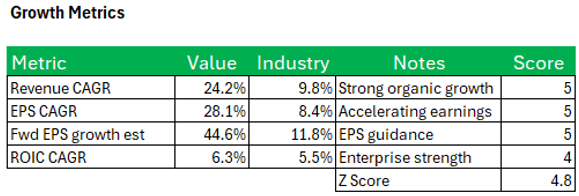
The growth score is 4.8 out of 5. Revenue, earnings, and ROIC are growing at a pace that is much faster than the industry averages. Looking forward, analysts project EPS to compound at a 44% annual clip.
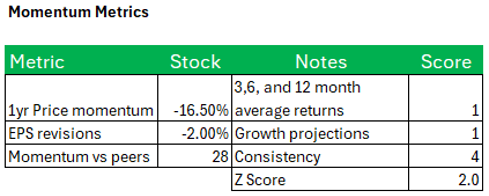
This is where the recent price weakness shows up the most. Price momentum over the past year has been fairly dismal, and analysts have cut EPS estimates as a result. But there's an upside to this - poor momentum means lower entry prices, and that's very attractive for a company that is as strong as TBBK.
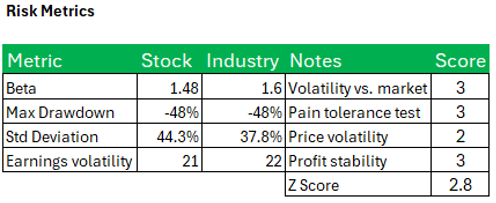
The risk score measures how volatile a stock is. It looks at the worst drawdowns of the last 5 years. It also considers the volatility of returns, or standard deviation. This high-beta stock is solid on growth, value, and financial strength but it falls down a little in the risk and momentum categories.
The Dashboard
Now we put all the scores from all the metrics into a single dashboard to make it easy to see the strengths and weaknesses of buying TBBK right now. Personally, I think it's worth the risk.
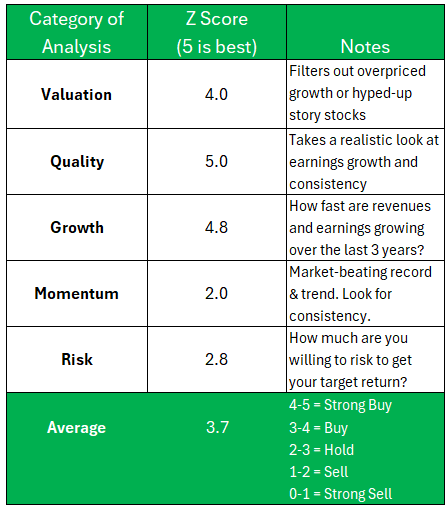
The final Zen Score from the dashboard is a composite rating that evaluates a stock's alignment with disciplined investing principles. It's not just about performance - it's about how that performance is achieved, and whether it is sustainable. Due your Diligence - decide whether it would be suitable for your existing portfolio. I would call this a 'moderate risk, high reward' wager. So, the expected value is higher than it is today, in my opinion.