
A Brief History of Bear Markets And Their Causes
| A bear market is defined as a decline of 20% or more from the most recent record high price. |
| Based on historical data, here are the major bear markets in the S&P 500 since 1950: |
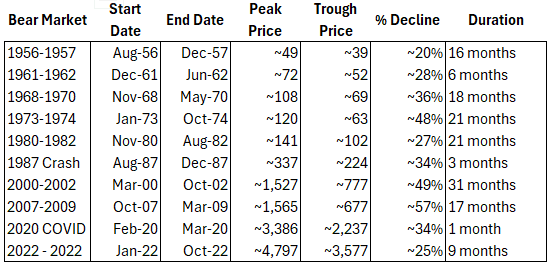
Key Statistics:
Total bear markets since 1950: 10
Average frequency: Approximately once every 7 years
Average duration: 14.3 months
Average decline: ~34%
Shortest bear market: 2020 COVID crash (1 month)
Longest bear market: 2000-2002 dot-com crash (31 months)
Largest decline: 2007-2009 Global Financial Crisis (-57%)
Notes:
Prices are approximate and based on closing values
The 1987 crash was particularly notable for its speed and sharp recovery
The 2020 COVID bear market was the shortest on record but had a rapid recovery
Bear markets often coincide with economic recessions but not always
Recovery times vary significantly, from months to several years
Causes of Each Bear Market:
1956-1957 Bear Market (~20% decline)
Cause: Economic recession and tightening monetary policy
Federal Reserve raised interest rates to combat inflation
Industrial production declined and unemployment rose
1961-1962 Bear Market (~28% decline) - "Kennedy Slide"
Cause: Corporate profits were lower, and the S&P 500 had fallen by 22% during the Kennedy Slide
Concerns about government intervention in business (steel price confrontation)
Rising interest rates and economic uncertainty
1968-1970 Bear Market (~36% decline)
Cause: Vietnam War spending and monetary tightening
Inflation concerns led to higher interest rates
Economic recession began in December 1969
1973-1974 Bear Market (~48% decline)
Cause: Oil crisis and stagflation
OPEC oil embargo quadrupled oil prices
Nixon wage and price controls
Watergate political crisis
Deep recession with high inflation
1980-1982 Bear Market (~27% decline)
Cause: Volcker's aggressive interest rate policy
Federal Reserve raised rates to extreme levels (20%+) to combat inflation
Severe recession with high unemployment
Iranian hostage crisis added to economic uncertainty
1987 Bear Market (~34% decline) - "Black Monday"
Cause: Program trading and those using a hedging strategy known as portfolio insurance
Rising interest rates and concerns about market overvaluation
Computer-driven selling accelerated the crash
Trade deficit and budget deficit concerns
2000-2002 Bear Market (~49% decline) - "Dot-com Crash"
Cause: The bursting of the Tech Bubble led directly to the 2000-2002 bear market
Overvaluation of internet and technology companies
Many companies had no profits or viable business models
Federal Reserve raised interest rates to cool the economy
2007-2009 Bear Market (~57% decline) - "Great Recession"
Cause: The Global Financial Crisis created the 2007-2009 bear market as the housing market imploded
Subprime mortgage crisis and housing bubble collapse
Banking system failures and credit crunch
Lehman Brothers bankruptcy and financial contagion
2020 Bear Market (~34% decline) - "COVID-19 Crash"
Cause: The last bear market in early 2020 was caused by the onset of Covid-19, a global pandemic, and the economic contraction that followed
Global economic shutdowns and uncertainty
Massive disruption to business operations and supply chains
Unprecedented government intervention and monetary stimulus
2022 Bear Market (~25% decline)
Cause: Markets again reeled, this time in response to Federal Reserve interest rate hikes aimed at slowing growth that had stoked red-hot inflation
Highest inflation in 40 years
Aggressive Federal Reserve rate hikes
Supply chain disruptions and geopolitical tensions (Russia-Ukraine war)
Concerns about economic recession
My Observations
Those of you reading this who are buy & hold types, I would like for you to consider this: Bear markets are destructive in two main ways - money and time. For money, there's the drawdown in the value of your invested wealth (aka your financial future) of course. I don't know very many buy & holders who would sit still and take the pain of a 50% loss of their retirement savings. What usually happens is that they throw in the towel at some point close to the bottom of the bear market cycle.
For the time part of bear markets, the damage is especially harsh. Money can always be replaced, but you never get beck the time you spend underwater during a bear market. Wouldn't it be better to have a plan in place that would walk you through the specific steps to take when the market starts to misbehave?
That's what we do here is plan for the inevitable bear markets so that we can limit the amount of pain we have to suffer from them. It's not that hard to do if you have the right tools and the skills to use them.
If you're interested in learning more about playing defense with your portfolio, drop me a line at erik@zeninvestor.org. There's no charge for a brief consultation.