
Invest Smarter with the
Monthly Intelligence Report
If you're uncertain about what's coming next, and don't know whether to be buying aggressively or pulling back, the Monthly Intelligence Report (MIR) may be
just what you need.
I understand the uncertainty and confusion because prospective subscribers express these feelings to me every day. They ask questions like...
"Is it safe to get back into the market now?"
"Will I be buying just before the next crash?"
"Should I wait for the next correction
before I buy?"
MIR is designed to provide answers to these pressing questions. My subscribers use the MIR as their North Star - guiding their decisions as they navigate the market.
The MIR looks into the future by carefully studying what has happened in the past under similar circumstances. It considers all of the possible outcomes for the market and the economy and assigns probabilities to each. (More details to follow.)
Once the probabilities are established, it displays a simple dashboard that captures the probabilities in an easy-to-understand format.
MIR also looks for investment opportunities that others have ignored. These include stocks and ETFs each month.
We don't ask "What is possible?" but rather "What is probable, or what is the most likely outcome?"
If you want to move from uncertainty about what may lie ahead, to what's likely, the MIR is for you.
Monthly Intelligence Report
The Monthly Intelligence Report (MIR) is designed to do three things.
First, reduce the uncertainty. My subscribers hear both the bull case and the bear case about what's happening in the market and the economy. But which one is more likely to come to pass? I answer this question by using Bayesian Probability to determine the likelihood of future outcomes.
Second, provide the reader with intuitive visuals that make it easy to see what's going on
and how it will affect prices.
And third, it highlights my top stock and ETF picks for the coming month.
Here’s What You’ll Get When You Subscribe.
When you subscribe to the MIR, you get immediate access to all past issues, including the most recently published one. Each issue is loaded with charts, graphs, tables, and original commentary that you won't find anywhere else.
But you get much more than just the monthly newsletter. Every subscriber to the MIR automatically becomes a Full Member of ZenInvestor, with all the perks and privileges that come with it.
Below you will find examples of what's included in every issue.
Key Market Indicators
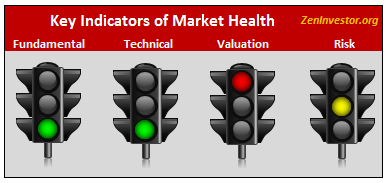
This is a visual representation of the health of today's market. Each traffic light summarizes the inputs from four categories - Fundamental, Technical, Valuation, and Risk. It's an easy way to assess the current market climate.
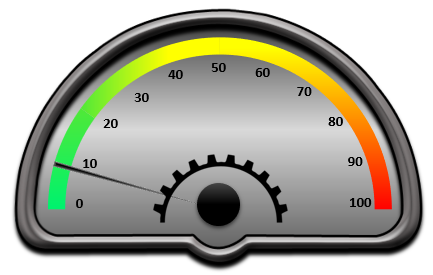
Bear Market Gauge
This visual represents the likelihood that a bear market will begin sometime within the next 3-6 months. It enables subscribers to adjust their asset allocations before the bear market takes hold.
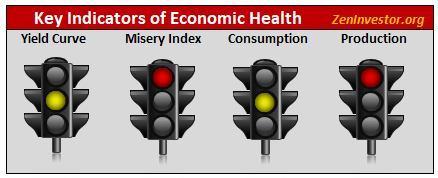
Key Indicators of Economic Health
This visual summarizes the health of the economy using four categories - Yield Curve, Consumer Health (Misery), Consumption trends, and Production trends. It's an easy way to assess current economic health and direction.
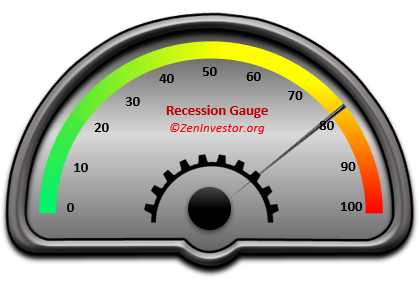
Recession & Recovery Forecast
This visual represents the likelihood that a recession will begin (or end) sometime within the next 6-9 months. It enables subscribers to stay ahead of economic events.
Here’s what people are saying about the Monthly Intelligence Report

Colleen Lindberg
Psychology professor at Loyola University
I was impressed by your ability to put us at ease and walk us through the tricky process of understanding the market and the economy. You do excellent work. Thank you!

Stephen Drake
Financial Manager, The Villages of Florida
I have been a client of Erik since 2008. He helped me recover from the bear market by completely revamping my portfolio design. He knows his stuff, and he actually listens. That's a new experience.
Here's what’s in the Monthly Intelligence Report
1
Section 1: Executive Summary
Each report begins with bullet points that neatly summarize the content. For example:
• The overvalued U.S. stock market has more upside.
• The Non-U.S. stock markets have even more upside.
• U.S. GDP is declining but is still in a positive growth mode.
• Global GDP growth forecasts have deteriorated slightly.
• Both of our models continue to raise caution slightly.
• Cash remains at 20% in the model portfolio.
• The employment situation is likely to get worse in the coming months.
• Sovereign debt levels are in bubble territory
2
Section 2: The Global Economy
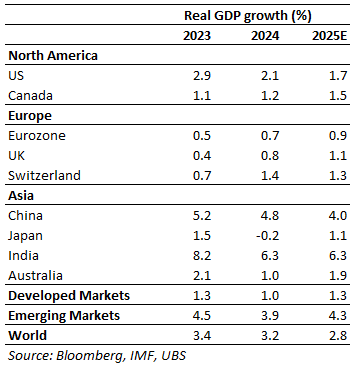
Next we describe the current state and future direction of the global economy. We include tables that give details by country and probabilities of various scenarios.
3
Section 3: The U.S. Economy
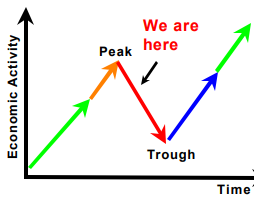
Next we address the current state and future direction of the U.S. economy. Here is an example of the visuals we use to support our analysis.
4
Section 4: The U.S. Stock Market
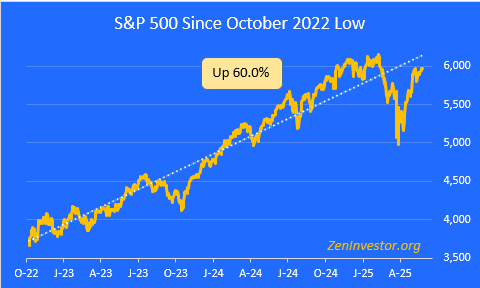
Next we tackle the U.S. stock market. We ask and answer questions like "What sectors are currently in favor?" and "Which sectors stand to benefit the most from changing economic conditions?" As always, we use charts and tables for this section.
5
Section 5: The Models
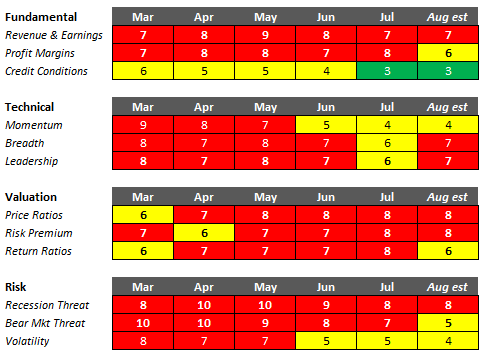
Now we get to the heart of the report - the models. There are two models, one for the stock market and the other for the economy. Shown just below is the stock market model, which assigns a rating, from 1-10, for each indicator that we track.
A rank of 1 is the best an indicator can get, while 10 is the worst. The individual ranking numbers for each indicator are color coded for easy identification. The colors correspond with the traffic light visual we showed earlier.
(The economy model works the same way, using key economic indicators.)
6
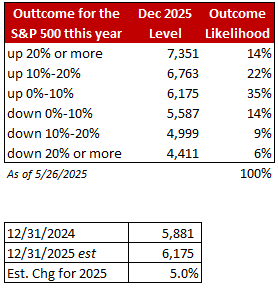
Section 6: Probability of future market outcomes
EWe all want to know what's in store for the market, and this table assigns a probability to each of the possible outcomes going forward. It's based on Bayesian Inference, which considers all outcomes from the past, given current conditions.
7
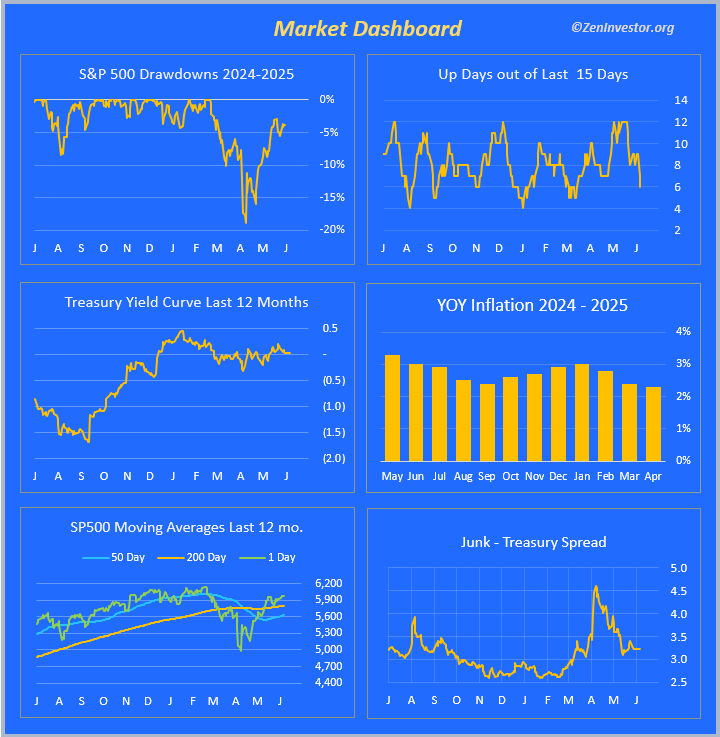
Section 7: The Dashboard
Many subscribers have told me that this is the first visual they look at when a new report is posted. It neatly summarizes the following:
- Drawdowns - how far are we from the most recent high water mark?
- Up days out of the last 15 days - a good indicator of market momentum.
- Treasury Yield Curve - an important clue about the health of the economy.
- Year-on-year change in the S&P 500 index - compares this year to last year.
- Moving Averages - a great way to gauge momentum in the equity market.
- Junk-Treasury bond spread - how much of a premium are bond investors demanding?
8
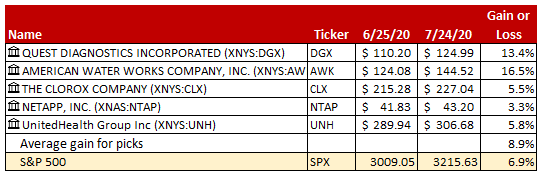
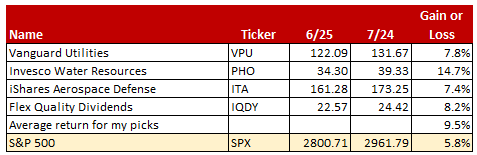
Section 8: My top stock and ETF picks for the next month
Since I began offering these monthly picks, they have beaten the market by 3.6% per year on average. I'm a stock-picker at heart, and I'm pretty good at it. But this isn't the main attraction of the MIR. The main attraction is using the MIR to avoid the pain and suffering that comes with recessions and bear markets.
This Month's Top Stock Picks
This Month's Top ETF Picks
T. Erik Conley
Head of Equity Trading at the Northern Trust Company in Chicago. Senior equity trader for the Oakmark family of Mutual Funds. Registered Options Principal and Risk Manager at Oakmark Funds. Head of Trading at Kemper Securities Convertible Arbitrage Desk. Head of Securities Lending at Blunt, Ellis & Loewi in Milwaukee, WI.
In each of these roles I learned the value of humility. Nobody knows more than the market, and as soon as you believe that you do, your downfall will quickly follow. Never confuse brains for a bull market.

Why The Monthly Intelligence Report Is So Valuable
If you are hooked up with a broker, you are probably getting a free newsletter. But how good is it if they are giving it away for free? Will they tell you when it's time to pull back and play defense? Not very likely, because brokers want to keep you invested at all times.
Why? Because when you go to cash, that money doesn't earn much for the broker. And it's easy for you to move the cash to another account outside of the broker's control.
Let's go through the numbers.
Say your account value is $500,000. Your broker charges you what, 1% of that balance every year, or $5,000? Or maybe he's a discount house who only charges 0.5% per year, or $2,500. What does that buy you? A free newsletter? That isn't exactly free, is it?
And don't forget that the free newsletter is biased to keep you fully invested at all times.
That's not the case with ZenInvestor. We are completely independent and bias-free. When we offer an explanation about something that happened in the market, you can count on our perspective being honest and unbiased. .
Monthly Subscription
$
60
Annual Subscription
$
600
Frequently Asked Questions
I get this question a lot. It's a fair question. The best way I can answer it is by pointing to the fact that I came up from the trading side of the business. Darwin's survival of the fittest assures that weak traders wash out and only the strong survive.
My newsletter is based on hard evidence rather than conjecture. I'm a student of the markets and I never stop questioning and learning. My models are based on Bayesian Inference and probability theory rather than guesswork.
Informally, just with private clients, since 2005. I began publishing to the general public in 2008.
I have a very good track record. Of course some of my picks haven't beaten the market, but you can see my complete track record here.
Yes. Every issue of the newsletter includes an asset allocation model. Since I have no way of knowing your specific circumstances, my model is tactical in the sense that I raise and lower allocations to broad categories like cash, equities, bonds, commodities, and alternative investments.
I advocate passive with a defensive overlay. When a recession is looming, investors are wise to play at least some defense. The newsletter addresses this directly, with specific steps a subscriber can take to protect their savings.