

I’m about to praise my own stock-picking prowess to the heavens, but before I do, a little background is in order.
I am not a stock-picker. I have no special gift for spotting the next Google or Amazon. I have no idea which stocks will beat the market and which will lag. I don’t have a crystal ball. I’ve been lucky, and that’s all there is to it. I’ve managed to beat the market with my annual picks for eight years running, and it’s as much down to luck as it is to skill.
But I do have a system. I’ll explain how it works in a minute, but first take a look at the results of my picks from last year.
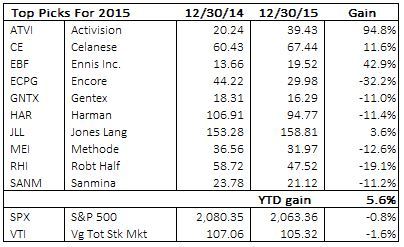
For 2015 my picks were up 5.6%, versus a small loss for the broad market. Most of my out-performance was due to just two stocks – Activision and Ennis Inc. Do you see what I mean when I say that I’ve been lucky? But let’s be fair (to me). It’s not entirely luck, because as I said, I do have a system. I don’t just throw darts at the Wall Street Journal stock tables. There’s a method behind what I do. But anyone who beats the market repeatedly, as I have done for the last eight years, must have a certain amount of luck on his side.
Now let’s move on to the issue of how I arrive at my stock picks. For the last eight years I have published a list of stocks that I thought would be solid performers over the following 12 months.
In coming up with this year’s list, I used the same screening process that has worked so well since 2008. Why mess with success? Here’s a quick review:
Starting with a universe of 8,000 stocks, I first screened for the ones that are rated 1 or 2 by Zacks Investment Research. This screen is all about earnings – growth, positive surprises, and upward revisions. This narrowed the list of candidates to about 900 names.
Next, I cross-referenced the Zacks list with Vector Vest’s top-rated stocks (VST score greater than 1). The VectorVest screen looks at price history to determine momentum, and various measures of relative value. This complements the earnings focus of the Zacks screen. The list of candidates that pass both of these screens is down to 388.
Lastly I ran the surviving names through the Thomson Reuters research screen, and kept only the names that scored at least an 8 on their 10 point scale. This screen consolidated the opinions of all the analysts who cover the stocks, and it gives more weight to those analysts who have proven to be the most accurate over time.
The 10 stocks that made it through all three of these screens appear below. As you can see, they represent a variety of sectors and industry groups.
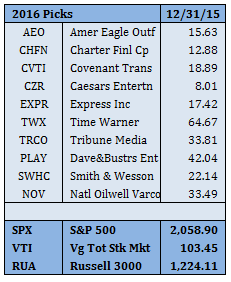
The advantage of using this three-screen approach is that each source focuses on a different aspect of what makes a stock attractive. It’s a Bayesian approach to stock selection. You begin with a prior probability (the Zacks rank has a history of identifying winning stocks), and you further refine the list by adding layers of non-correlated screening criteria.
I didn’t spend months analyzing financial statements and visiting these companies in person. I’m relying on the analyst community to do that for me. My methodology takes into account a consensus of top analysts, and how their earnings estimates have changed over time.
I can be reasonably confident that these are solid companies, producing solid and growing earnings, and they can be a reasonable addition to your own process of picking stocks, as long as you do your own due diligence. I do not recommend that anyone blindly follows my picks – always do your own research.
(Disclosure: I have long positions in SWHC and VLO)