

Brawndo: It's got what plants crave - Electrolytes.
(And this article has everything you crave about ETFs.)
I've been a student of the market for many years, and one of the developments that has fascinated me is the advent of the ETF, or Exchange Traded Fund.
The story of the arrival of ETFs and the nearly unfathomable popularity they have generated is really a story of the market giving investors what they crave - low cost, easily tradeable securities that give them instant access to a wide variety of asset classes, factors, sectors, countries, and many other things that were heretofore only available to the ultra-rich and big institutional investors.
I admit that I have been smitten by the ETF tsunami, and I believe that, with proper guidance, any investor can now put together a portfolio that will match anything that Yale or Harvard have.
The ZenInvestor ETF Database
I have been working for a long time on coming up with a database of ETFs that solved two problems. First, the overwhelming number of choices available. And second, the daunting task of sifting through all of these choices in a way that is easy and intuitive for anyone who wants to build a well-diversified portfolio that doesn't require the expensive advice of a financial advisor.
I'm happy to announce today that I have finally come up with a reasonable solution to these two problems. It's not perfect, but it's a good starting point. I will continue to tweak this database, based on reader feedback and suggestions from the crowd.
My ETF database is nearly all-inclusive, meaning that there might be a few newcomers that escaped my screens, but I don't think it's a problem worth worrying about. As you will see, there are dozens of ways to slice and dice the market, and having a searchable database can be a valuable tool in your toolkit.
The Big Picture
What I'm going to do today is present a few of the highlights that I've gathered from looking at the entire ETF universe. I will also include a link to my master spreadsheet that has all of the information I could find from four sources:
The Summary Statistics
The way I chose to slice-and-dice the ETF universe is by taking the methodology of AAII. According to their analysis, there are 60 ETF categories. In my opinion, that's just too many. But I'm trying to present a birds-eye view of the ETF universe, so I will include everything in this first article.
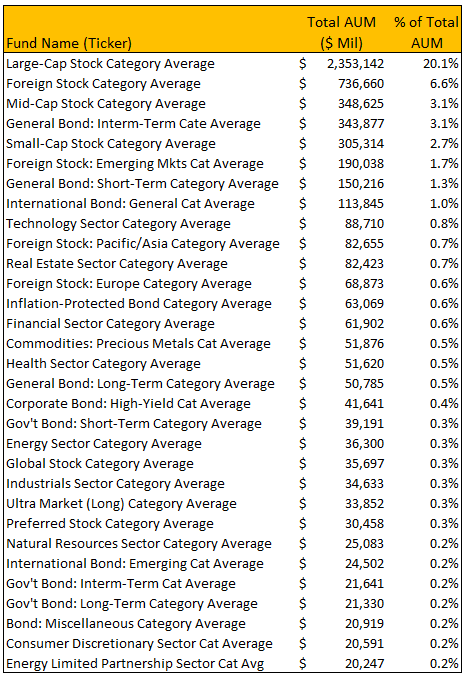
I'll begin with a list of ETFs by category, sorted by total assets invested. This will give you a sense of where the big money is invested right now. I'm only showing ETFs that have at least $20 Billion invested for the purpose of brevity. Remember that the full database is linked in this article.
The Table
How to use this resource
When building a portfolio, I think it's important to consider first what asset classes to include. Obvious choices are stocks, bonds, REITs, maybe commodities, or whatever. You will have to do some research on which asset classes are the most likely to perform well during the next 12-24 months, and then go through the list of ETFs to pick the ones that will represent your asset class choices in the way you want.
Tune in next time when I drill down into some of the major asset classes with the purpose of uncovering key differences and how they may play out going forward.