

This is a real thing, believe it or not.
A few years back, when I was managing money for wealthy clients, it occurred to me that most of the mutual funds and trading systems out there were weak at best, and downright harmful for the investor at worst. Mainly it had to do with two things - high fees that made it virtually impossible for the investor to make any real money, and sloppy strategy design which caused sub-par performance.
So I had an a-ha moment. Why not launch an investment product with no hype, no spin, and no made-up performance numbers? Just the truth about expected returns over time. It was a radical idea, and my associates thought I was nuts for even bringing it up. But that's not the end of the story.
As my cohorts had a good laugh at my expense, I began to work on an investment strategy that actually worked. My goal was to under-promise and over-deliver real performance in a marketplace that was crowded with sub-par products designed to enrich the sellers and not the buyers.
I made this my mission
I began by looking at the performance history for as many different strategies I could find. I looked at virtually everything that was available at the time. What I found was that most (85-90%) of the products being sold by Wall Street were nothing more than a way to capture client assets and turn them into annuities for the manufacturer and promoters. By that I mean the client assets generated a steady 1-2% income stream for the broker, advisor, planner or fund manager. No work involved. Just keep everyone quiet.
This mission I had embarked on eventually led me to the granddaddy of all You Could Do Worse investment strategies - Buy and Hold (hereafter BH). I want to be clear about one thing - I have no problem with BH as a strategy per se. From a practical standpoint, BH is usually the best choice for investors who don't want to spend any more time than is necessary on their investments. That's completely rational.
Expected returns from a BH strategy
But here's the point I'm trying to make. If an investor chooses BH as their strategy, let's be honest and call it what it really is - the You Could Do Worse strategy. What's wrong with that? If you follow the BH strategy correctly (no cheating by pulling back on your market exposure when the market is in a tailspin) then you will enjoy everything that the market has to offer.
That comes to roughly a 9.5% return on your money. After inflation it's roughly 6.5% on your money. And after taxes it's roughly 5% depending on your bracket, of course. Oh, and don't forget fees and expenses. If your account is being managed by an investment professional, deduct fees of 0.8% to 1.2% per year. If you are a DIY investor, you only have to pay the fees that your broker charges. Things like commissions, admin fees, fund management fees, trading slippage, and the like.
Compromises required for BH investors
No matter how you slice it, a BH investor will not earn the market return after taking expenses into account. But remember - You Could Do Worse than BH as a strategy.
If you are o.k. with these average returns on your investments, then BH is the right strategy for you. You can just "set it and forget it." When new money comes in via monthly contributions to your retirement plan or year-end bonuses, just allocate the funds according to your original asset allocation model. Easy-Peasy. But be aware that there are certain compromises you will make when you use BH.
Compromise #1. Time.
BH requires that you remain fully invested at all times, through bull and bear markets, through economic recessions, through wars and natural disasters and serious policy mistakes by our fearless leaders in Washington. And through spikes in interest rates and the inflation rate.
BH in its' pure form, requires you to stay the course and take whatever punishment the market doles out. Advocates of BH, and there are many, will tell you that the market goes up and down and always returns to good form eventually. That's true. But did you know that a bear market can take as many as 10 years to fully recover and get back to its previous high-water mark?
Are you willing to give up 10 years of your limited investment lifetime just to wait out the next bear market? I'm not, and this is a major drawback of the BH strategy. You will never get those lost 10 years back. There has to be a better way.
Compromise #2. High Anxiety
Bear markets can, and do, reduce the value of stocks and other financial assets by 50% or more before they finally exhaust themselves. Ask yourself this question - do you really think you can sit back and do nothing to protect your nest egg when the market is tanking month after month, with no end in sight? Only the most determined and disciplined among us can lay claim to that ability. Most of the rest will end up cheating on their BH strategy and bail out, at least partially.
Compromise #3. Increasing the risk of falling short of your investment goals
We all have a finite amount of time to accumulate enough money to sustain us in our golden years. If you fritter away 10 years of this precious, non-replaceable resource you will be increasing the risk that you will not make it to the finish line with the amount of capital you had counted on when you started out.
Compromise #4. Inflexibility
With a BH approach you would typically choose a set of asset classes to invest in. The simplest would be something like 70% stocks and 30% bonds. You can add more granularity to the mix, but once your asset allocations are set, you are stuck with them.
But wait a second you might say. Why can't I change my asset allocation as I go along? The answer is that when you do that, you are no longer a BH investor, you're an active investor. Or worse, you're a market timer, or maybe even a stock picker. Heaven forbid.
Truth is that very few self-described BH investors are really BH investors. There are just too many forces at work to distract us and force us to deviate from our original plan. So I came up with a crazy idea that just might work. It's called Buy & Adapt.
You Can Do Better
Instead of settling for the You Could Do Worse approach to investing, wouldn't it be better to adopt a You Can Do Better strategy? It's not that hard to do. You won't have to spend countless hours every month tinkering with your investments to keep the plates spinning. All you have to do is set up a contingency plan that lays out, step-by-step, what actions you will take to protect your nest egg from the worst bear markets that happen about every 8 years.
Your contingency plan doesn't have to be complicated. It can (and should) fit on a single page, as long as it has explicit instructions about what you will do when certain conditions are present in the economy and/or the stock market. Below are examples of what a contingency plan might look like. The details aren't as important as the process of thinking about a defensive strategy and committing it to paper.
A Contingency plan based on market valuations
There are several ways to gauge the level of risk in the equity market. Where we are in the business cycle, for example. Changes in Fed policy on short-term rates is another one. For this article I'll use valuations as the risk indicator and use it to adjust my portfolio's asset allocations.
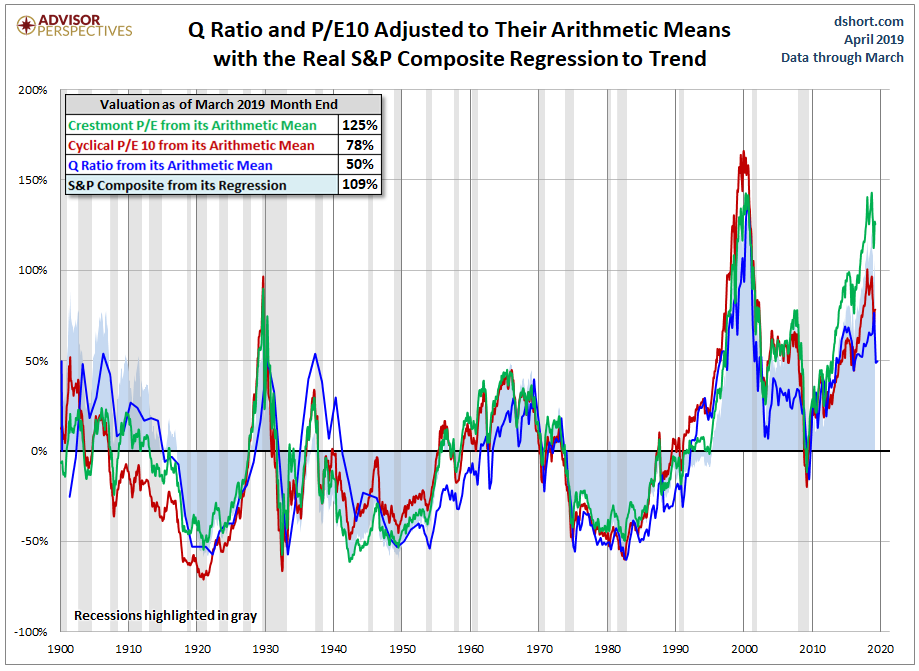
The chart below is from Jill Mislinsky and Doug Short. It tracks 4 indicators of market valuation, which can be combined into a single number. Take a look at the chart, and after that I'll give an example of what a contingency plan might look like if it were based on this valuation indicator.
A simple contingency plan based on market valuation
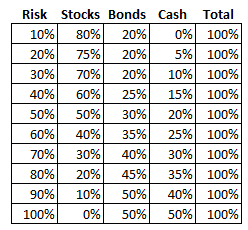
The idea here is to create a series of "if - then" statements that match the above table. If the combined valuation indicator is less than 20%, then allocate as indicated. When the indicator gets to 20%, adjust your allocations accordingly. And so on, until you get to a full blown bear market and/or recession. By that time your equity allocation would be zero.
This is simply a framework for you to use when setting up your own contingency plan. There is no magic in the numbers I've used here. It all depends on your, or your client's risk preferences.
When you set up your contingency plan, you have to be committed to following it faithfully. If you do that, having a contingency plan is the essence of the You Could Do Better investment strategy.
With havin so much written content do you ever run into any problems of plagorism or copyright infringement?
My site has a lot of unique content I’ve either written myself or outsourced but it looks
like a lot of it is popping it up all over the internet without my permission. Do you know any methods to help stop content from being stolen? I’d truly appreciate
it.
Simple & Zen words… at least the pragmatic view on how B&H is actually executed by an avg investor. Not sure if it results in more returns- at least it is less anxious this way.
Btw – this chart was great. Looks like we are overdue for a cross over below the black line…hope not, but it will… that’s a natural phenomenon…