

The Big Question
Is this the start of a major correction, or even a bear market? I don't think so. The market just endured a violent repositioning and volatility is probably here for a while. But a bear market still requires a catalyst, and it's hard to find one in an economy growing above 3% with unemployment near 4%.
A lot has changed. Politics, investor psychology, the willingness to endlessly fund every AI project changed. There is a meaningful difference between believing AI will reshape the economy and believing every company connected to AI deserves an unlimited valuation. The market appears to be discovering that distinction in real time.
The view from 10,000 feet
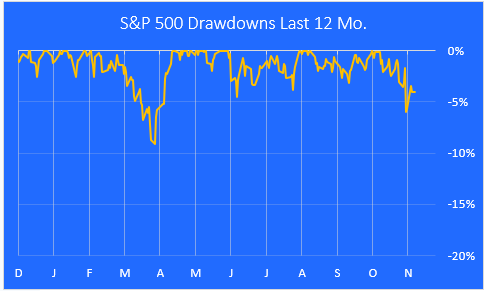
To see how far the market has fallen, focus on the upper-right corner of the chart below. You can see the sharp decline we had last Thursday, and the two-day rally (so far) that has followed.
What looks most vulnerable here are the areas of the AI trade that depended on ever-rising capital commitments. If funding becomes scarcer, some projects will be delayed, some assumptions will prove too optimistic, and some business models will come under pressure. Not every participant in the buildout will make it through this rough patch unscathed.
Yet it is equally hard to argue that artificial intelligence suddenly disappeared last week. Demand for compute remains substantial. Memory remains tight. Companies are still looking for ways to automate processes and improve productivity. The amount of AI spending hasn't changed, but the pace of spending might have.
Meanwhile, the broader economy continues to carry more weight than many investors seem willing to acknowledge. Consumers are spending. Employers are still hiring. Those aren't the conditions that typically accompany the start of a deep economic contraction.
That creates a different investing environment than the one investors have become accustomed to. Leadership may rotate. Some former winners may need years rather than months to justify prior expectations. Other businesses that were largely ignored during the AI frenzy may finally get a chance to outperform.
The market is trying to determine what deserves a lower multiple and what was simply caught in a liquidation. Those are not the same thing. In a sharp market downturn, liquidity is the name of the game. Big investors tend to sell their most liquid names, and a big part of that cohort is the semiconductor industry and its ancillary businesses.
When and how
For now, this looks less like the beginning of a total market collapse and more like a large-scale repricing of risk. History suggests those episodes can be confusing and chaotic. They can also create opportunity. Don't mistake forced selling for fundamental deterioration.
This is just another dip - it's just deeper than what we are used to. After last Thursday's big down, there were plenty of very good companies that were selling at bargain prices. Friday's small bump higher pushed many of the bargains back up into overvalued status.
Today, Tuesday, is another down day but so far it has been more orderly. So I think some of these bargains will reappear if we close lower. The time to buy the dip is now, but don't do it all at once. First, take a full accounting of how much cash you can comfortably spend on bargains. Then do a rough estimate of how many positions you can comfortably take on at this point. Next, size each new position according to your conviction, and you will be ready to go.
But go slowly. If the market has another leg down, you want to have some cash available to take advantage of it. I'm at 10% cash now, and I'm not in a hurry to buy, with a few exceptions. You will do the same kind of calculus and let the market come to you.